
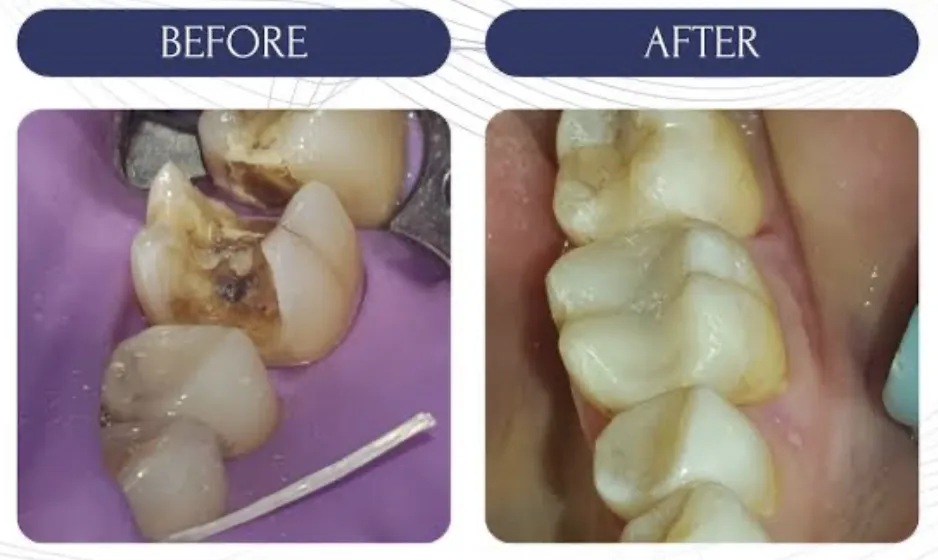
When decay in a milk tooth reaches the nerve (pulp), the child usually has pain, especially at night or while eating. A pulpotomy removes the infected part of the pulp in the crown of the tooth and seals the healthy part that remains in the roots.
This relieves the pain and keeps the tooth in place until it is ready to fall out naturally — which is better for chewing, speech and the spacing of the adult teeth.
If the infection has spread further into the roots, a pulpectomy (complete cleaning of the root canals of the milk tooth) may be needed instead. The tooth is usually protected with a stainless-steel or tooth-coloured crown.
Pulpotomy (Baby Tooth Root Canal) at a glance
- Sittings
- Usually one
- Anaesthesia
- Local, with a gentle approach for children
- After treatment
- A crown protects the tooth
- Child-friendly
- We explain each step in simple words
Why Save a Baby Tooth?
- Maintains space for the adult tooth
- Helps normal chewing and speech
- Prevents infection spreading to the developing tooth
- Avoids the need for a space maintainer
Signs Your Child May Need a Pulpotomy
- Toothache, especially at night
- Pain while eating or drinking hot, cold or sweet things
- A large cavity in a back milk tooth
- Swelling or a boil on the gum
How a Pulpotomy Is Done
- An examination and X-ray to see how deep the decay goes.
- The tooth is numbed gently with local anaesthesia.
- The decay and the infected pulp in the crown of the tooth are removed.
- A medicated material is placed over the remaining healthy pulp.
- The tooth is sealed and protected with a crown.
After the Treatment
Your child can eat once the numbness wears off — watch that they do not bite their cheek or lip while it is numb. Mild soreness for a day is normal. Keep up good brushing and regular check-ups so the crown and tooth stay healthy until the adult tooth comes in.
Pulpotomy (Baby Tooth Root Canal) at Duhita Dental
Patients from Benz Circle, Krishna Nagar, Gayatri Nagar, Patamata, Labbipet, Moghalrajpuram and across Vijayawada — and from nearby towns such as Guntur, Mangalagiri, Amaravati, Tadepalli, Tenali — choose Duhita Dental for experienced, specialist-led care, strict sterilisation and transparent pricing. Book a consultation or call 0866 247 4066 to discuss your treatment.
Frequently Asked Questions
Yes. It is a routine, well-established procedure performed under local anaesthesia.
The tooth is numbed first, so the treatment itself should not hurt. Most children feel relief once the infected nerve is treated.
A treated milk tooth is weaker and can break. A crown protects it until it falls out naturally.