
Root canal treatment (RCT) saves a tooth whose inner pulp has become infected or badly inflamed. The infected tissue is removed, the canals inside the roots are cleaned and disinfected, and the tooth is sealed so bacteria cannot get back in.
Many people fear a root canal, but the treatment itself is not what hurts — the infection is. With good local anaesthesia, modern RCT feels much like having a filling, and most patients leave with far less pain than they came in with.
At Duhita Dental, every root canal plan is reviewed by Dr. Sasidhar, an MDS endodontist. Using rotary files, an electronic apex locator and digital X-rays, many straightforward cases are completed in a single sitting.
Root Canal Treatment at a glance
- Sittings
- Often one; two for severe infection
- Time per sitting
- About 45–90 minutes
- Anaesthesia
- Local — the tooth is fully numb
- Back to work
- Usually the same day
- Afterwards
- A crown is usually advised, especially on back teeth
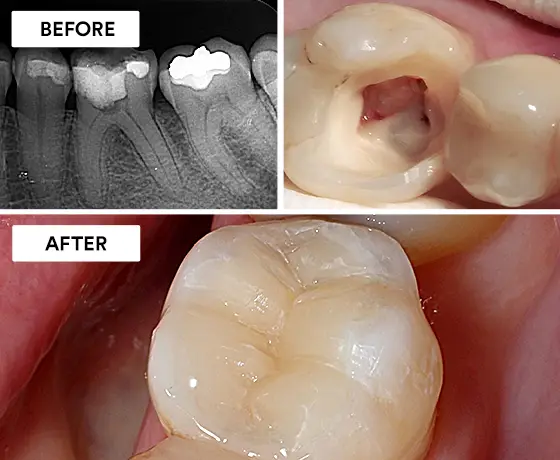
Signs You May Need a Root Canal
- Severe toothache, especially when chewing or biting
- Sensitivity to hot or cold that lingers after the food or drink is gone
- Pain that wakes you up at night
- Swelling of the gum or face, or a small pimple-like boil on the gum
- A tooth that has turned dark or grey
- A deep cavity or crack seen on an X-ray, even if it does not hurt yet
Some infected teeth cause no pain at all and are found only on an X-ray. That is one reason regular check-ups matter.
How Root Canal Treatment Is Done, Step by Step
- Examination and a digital X-ray to see the shape of the roots and the extent of infection.
- Local anaesthesia so the tooth and surrounding gum are completely numb.
- A small opening is made in the top of the tooth to reach the pulp chamber.
- The infected pulp is removed and each canal is cleaned and shaped with rotary instruments, while an apex locator measures its exact length.
- The canals are rinsed with disinfecting solutions to kill remaining bacteria.
- The canals are filled and sealed with gutta-percha, a rubber-like biocompatible material, and the opening is closed with a filling.
- Once the tooth has settled, a crown is placed to protect it from breaking.
Recovery and Aftercare
It is normal for the tooth to feel slightly tender for two to three days, especially when biting. Simple painkillers advised by your dentist are usually enough. Avoid chewing hard food on the treated side until the final filling or crown is in place.
- Brush and floss normally — keeping the area clean helps healing
- Take any prescribed medicines for the full course
- Call the clinic if swelling increases or pain gets worse after three days
- Do not delay the crown: an uncrowned back tooth can crack
Why a Crown After Root Canal?
A root-canal-treated tooth no longer has a living blood supply, and back teeth in particular become more brittle over time. A zirconia or metal-ceramic crown covers and holds the tooth together, protecting it from fractures so it can last for many years. Front teeth that are only slightly damaged sometimes need just a filling — we will tell you which applies to you.
What Affects the Cost of Root Canal Treatment?
There is no single price for RCT because every tooth is different. After examining the tooth and the X-ray, we give you a clear written estimate before starting.
- Which tooth it is — molars have three or four canals, front teeth usually one
- How severe the infection is and whether more than one sitting is needed
- Whether it is a first treatment or a re-treatment of an old root canal
- The type of crown you choose afterwards
Root Canal Treatment at Duhita Dental
Patients from Benz Circle, Krishna Nagar, Gayatri Nagar, Patamata, Labbipet, Moghalrajpuram and across Vijayawada — and from nearby towns such as Guntur, Mangalagiri, Amaravati, Tadepalli, Tenali — choose Duhita Dental for experienced, specialist-led care, strict sterilisation and transparent pricing. Book a consultation or call 0866 247 4066 to discuss your treatment.
Frequently Asked Questions
No. The tooth is fully numbed, and most patients report less discomfort than the toothache that brought them in.
Many cases are finished in one sitting of 45–90 minutes. Teeth with severe infection or swelling may need two visits so the infection can settle first.
Keeping your natural tooth is almost always the better choice. An extracted tooth needs replacing with an implant, bridge or denture to stop the other teeth drifting, which usually costs more and takes longer.
With a well-fitting crown, good brushing and regular check-ups, a root canal treated tooth can last for many years — often for life.
Yes, once the numbness wears off, usually after two to three hours. Choose soft food and chew on the other side until the tooth is crowned.
Cost depends on the tooth and number of canals. We share a clear written estimate after examination and X-ray.